Explain the Game
Be a Defender
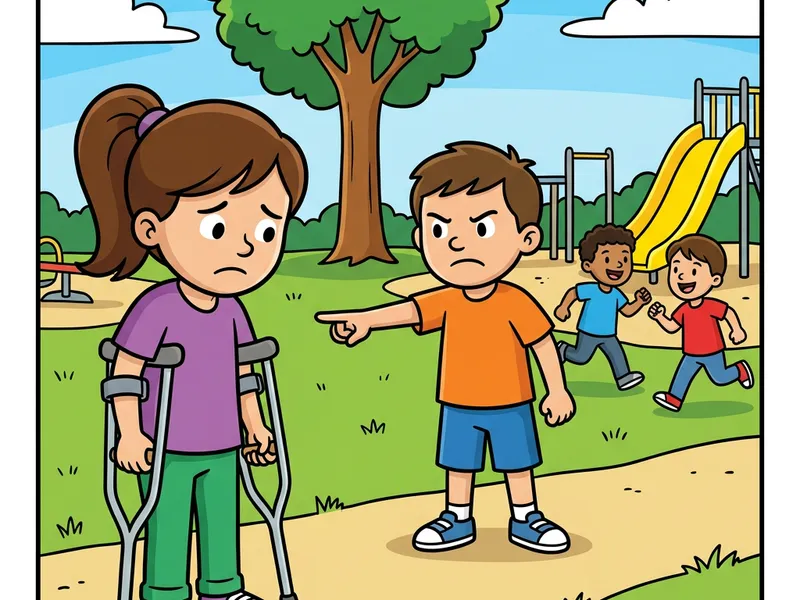
When someone is teased, a defender helps. Children try the choices at the shelter, at school and at recess, and find four safe ways to help, including telling a grown-up.
- Grade band
- Grades 1 to 3 (ages 6 to 9)Also works for grades 4 and 5 as a discussion starter.
- Time
- About 10 minutes
- Format
- Solo on a device · Whole class on a smartboard
- Reading demand
- Read-aloud lets pre-readers play.Has natural-voice read-aloud.
- Sound
- Optional with read-aloud.
- Book connection
- Daisy’s Different, where Daisy is teased.
Learning objectives
- Students will name safe ways a bystander can help someone who is teased.
- Students will explain that telling a grown-up always counts as defending.
Standards alignment
- CASEL SEL: Relationship skills and responsible decision-making
- Health education: Bullying prevention
Areas are listed by framework. Check the exact standard codes for your grade.
Talk about it afterward
- Which choice helped the most? How could you tell?
- What makes standing up for someone feel hard? What could make it easier?
- What is the difference between telling and tattling?
- What is one thing you could really do at recess this week?
Extension activity
Practice the brave words together, and post the list of grown-ups children can tell.
Why it works: Most children are watchers when teasing happens. Teaching watchers simple, safe ways to help reduces bullying, and telling an adult always counts as defending (Salmivalli et al., 1996; Garandeau et al., 2023).
Notes and sensitivities
Safety first
Children are never asked to put themselves at risk. If a child tells you they are being hurt, follow your school’s reporting steps.
General education, not medical or mental health advice. See the site documentation for privacy, accessibility and safety notes.