Explain the Game
Calming Breaths
A collection of 16 animated breathing techniques, from Daisy’s own “smell the daisy, blow out the candle” to box breathing for older kids. A calm natural voice talks children through every breath, and a picture grows and shrinks so they can match its pace.
- Grade band
- Grades K to 5 (ages 3 to 12)Preschoolers (age 3 and up) can use the playful techniques with a grown-up.
- Time
- About 1 to 3 minutes per technique
- Format
- Whole class on a smartboard · Calm corner device · Solo with headphones
- Reading demand
- No reading needed. Every cue is spoken aloud and shown with a moving picture.Has natural-voice read-aloud.
- Sound
- Natural voice guidance. Works with sound off, too: the picture shows when to breathe in and out.
- Book connection
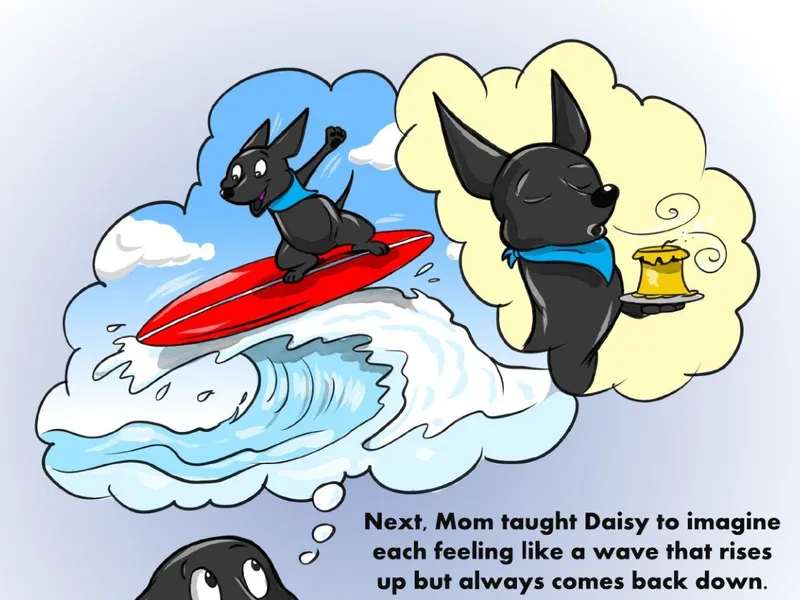
- Inspired by Daisy Can’t Help It, where Mom teaches Daisy to smell the daisies and blow out the candles.
Learning objectives
- Students will use slow breathing with a longer breath out to help their bodies calm down.
- Students will name two or three breathing tools they can use on their own.
- Students will notice how their body feels before and after breathing.
Standards alignment
- CASEL SEL: Self-management: managing emotions and stress
- CASEL SEL: Self-awareness: identifying emotions
- Health education: Mental and emotional health: healthy ways to handle stress
Areas are listed by framework. Check the exact standard codes for your grade.
Talk about it afterward
- Which breath helped your body feel the calmest?
- When could you use a breathing tool at school or at home?
- How did your body feel before, and how does it feel now?
Extension activity
Make a class “breathing menu” poster with three favorite techniques. Children can point to the one they want when feelings get big.
Why it works: Making the breath out longer than the breath in helps the body shift toward rest. A moving picture gives young children a pace they can see, and a short session keeps it doable.
Notes and sensitivities
Paced by age
Pick an age band before you start. Ages 3 to 5 get short, playful breaths with no holding. Ages 6 to 8 get slow breaths with a longer breath out. Ages 9 to 12 get longer, steadier breaths. Each session is only 3 to 7 breaths.
Gentle breathing only
Breathe gently. Never breathe so hard or fast that you feel dizzy. If you feel dizzy or uncomfortable, stop and breathe normally. You can stop any time. Children under 6 never get breath holds; the game removes them automatically.
A calming practice, not therapy
Calming Breaths is a general calming practice for every child. It is not therapy or medical treatment. If a child seems very upset, or has asthma or another breathing condition, check with the school nurse, counselor or the child’s doctor.
General education, not medical or mental health advice. See the site documentation for privacy, accessibility and safety notes.