Explain the Game
Surf the Urge
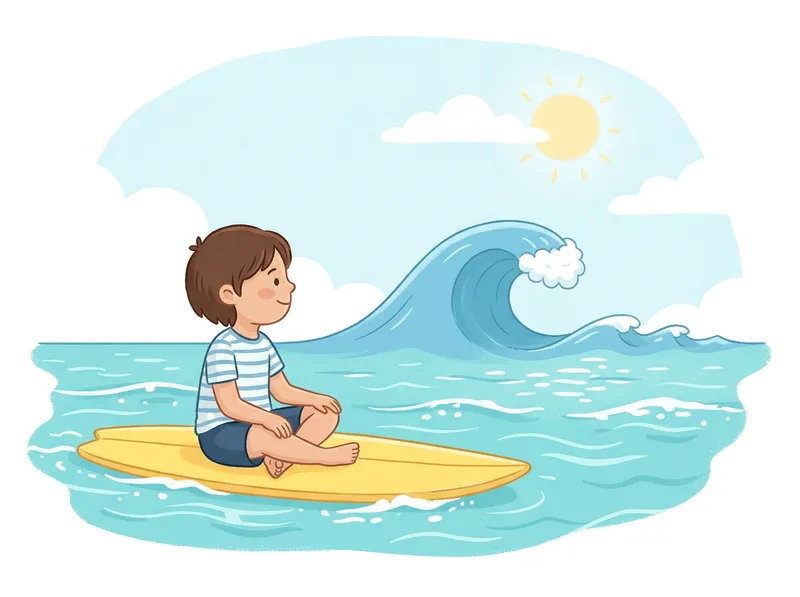
Children learn that an urge (a strong “I want to do it right now” feeling) is like a wave: it gets bigger, reaches the top, and gets smaller. They pick an everyday urge, say “I notice I want to …”, give it a size, find it in their body, take three slow breaths at the top, and check its size again at the end. A For grown-ups tab has a teaching guide.
- Grade band
- Grades K to 5 (ages 5 to 12)Best from age 6. Kindergartners can ride an urge with a grown-up reading each step.
- Time
- About 5 minutes to learn the wave, 3 to 5 minutes per ride
- Format
- Whole class on a smartboard (teach the wave) · Small group · Solo or calm corner on a device
- Reading demand
- Short sentences. Every step has a read-aloud button, so pre-readers can play with a grown-up nearby.Has natural-voice read-aloud.
- Sound
- Optional. A natural voice reads each step when a child taps Read to me.
- Book connection
- Inspired by Daisy Can’t Help It, where Daisy feels a big pull to chew and Mom teaches her to surf the wave of her feelings. Urge surfing itself is not in the book.
Learning objectives
- Students will describe an urge as a feeling that rises, peaks and passes.
- Students will name an urge out loud (“I notice I want to …”) and rate its size.
- Students will notice where they feel an urge in their body.
- Students will practice riding an urge without acting on it and without fighting it.
Standards alignment
- CASEL SEL: Self-management: impulse control
- CASEL SEL: Self-awareness: identifying emotions and body signals
- Health education: Mental and emotional health: healthy ways to handle stress
Areas are listed by framework. Check the exact standard codes for your grade.
Talk about it afterward
- What is an urge you had today? How big was the wave?
- Where in your body do you feel an urge?
- What happened to the wave when you just watched it?
- How is surfing an urge different from fighting it?
Extension activity
Agree on a class cue (“Surf it” or a hand making a wave). When an urge shows up during the day, use the cue, and have children say the urge and its size out loud.
Why it works: When children name an urge and watch it change, they learn first-hand that urges are temporary. Rating the urge before and after gives them proof, and practicing with small urges builds the skill before big ones show up.
Notes and sensitivities
Not the same as Surf the Wave
Surf the Wave in Calming Breaths is a breathing exercise: the board sets the pace of each breath. Surf the Urge is a noticing skill: the wave is the urge itself, and children watch it rise and pass without doing what it says. Slow breaths can help at the top, but the goal is noticing, not breathing.
Where it comes from
Urge surfing comes from psychologist G. Alan Marlatt’s relapse-prevention work. This is a gentle, kid-sized version for everyday urges.
A practice skill, not therapy
Use it for everyday urges like grabbing, yelling or blurting out. If a child has urges to hurt themselves or someone else, or urges that feel out of control, bring in your school counselor, social worker or the child’s care team.
General education, not medical or mental health advice. See the site documentation for privacy, accessibility and safety notes.